
Divine Wonders
He has made everything beautiful in its time. Ecclesiastes 3:11
How to Train Your Dragon
The live-action How to Train Your Dragon, released just last month, drew me back to the original animated story—and I was unexpectedly moved all over again.
Set on the Viking island of Berk, the story opens with a world where humans and dragons have been enemies for generations. Dragons were feared and hated as livestock thieves and village destroyers.
The main character, Hiccup, is the chief’s son, but he’s nothing like the other warriors in his tribe. He’s small, clumsy, and more drawn to tinkering and inventing than fighting. In a community that values strength and dragon-killing prowess, Hiccup stands out—for all the wrong reasons.
But the story follows Hiccup’s transformation: from trying to win approval by killing a dragon, to forming a bond of trust with an injured one—Toothless, a feared “Night Fury”—and eventually helping his people see dragons not as enemies, but as allies.
Two scenes in particular stayed with me.
Scene 1: “I’m a Viking!”

In a tense early moment, Hiccup creeps toward the wounded Night Fury, dagger in hand. He’s shaking, breathing hard, whispering to himself:
“I’m gonna kill you… and bring your heart back to my dad… I’m a Viking. I am a Viking…”
But then, he catches a glimpse of Toothless’s eyes—full of pain, fear, and desperation.
Something in him shifts. He sees not a monster, but someone… scared. Weak. Vulnerable. Like himself.
Instead of killing the dragon, Hiccup makes a risky decision: he cuts the ropes binding Toothless and sets him free.
In that moment, Hiccup is torn between the expectation to prove himself and the truth of who he really is.
The pressure to be a “real Viking” nearly silences his own gentler instincts—his empathy, intelligence, and compassion.
I wonder how often we feel the same.
The pressure to be what others expect—to fit in, to achieve, to prove our worth—can feel overwhelming.
But is that truly who we are?
The Bible says:
“Therefore, as God’s chosen people, holy and dearly loved, clothe yourselves with compassion, kindness, humility, gentleness, and patience.”
— Colossians 3:12
My worth isn’t defined by appearances, achievements, or how others see me.
My truest identity is this: I am chosen and deeply loved by God.
And when I rest in that identity, it changes how I see others too.
They’re no longer competitors or “the other.”
They, like me, are vulnerable and searching—worthy of compassion, connection, and love.
Just like Hiccup, I’m called to take the risk of setting others free from what binds them.
Scene 2: Sharing “Half a Fish”
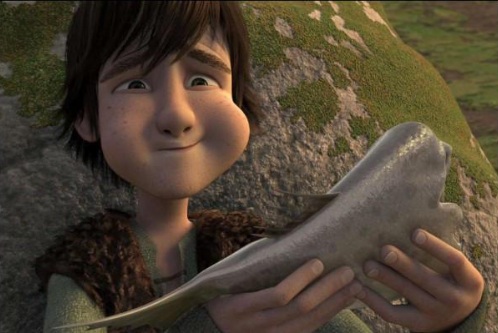
Later in the story, Hiccup brings a fish to Toothless. The dragon is hesitant, until Hiccup throws away his own dagger.
Toothless eats the fish—and then, in a surprise move, spits out half of it to share with Hiccup.
That was gross!
Hiccup hesitates, pinches his nose… and eats it.
That moment marked the beginning of real trust between them.
It reminded me of Jesus, who—though King of Heaven—chose to become like us.
He was born in a manger, raised in a carpenter’s home, shared meals with the outcast and rejected.
And in the end, He gave His life for us—even for those who mocked and crucified Him.
That half-eaten fish became, in my mind, a surprisingly perfect metaphor for the incarnation—God choosing to share our world, mess and all, out of love.
My prayer is this:
That I, like Hiccup,
won’t be bound by the world’s values,
won’t live trying to meet others’ expectations,
but will remember—always—who I truly am:
a beloved child of God.
May that identity free me
to truly see the people around me—
their fragility, their hunger, their hopes—
and to take the risk of stepping in,
crossing the gap,
even eating the “half a fish,”
for the sake of love.

—Ephesians 5: 1–2